• Home
  • Work
  • Team
  • Events
  • Blog
  • Community

Blog / Opinion essays

An opinion essay shares the personal perspective of a Topos community member, as part of opening up our research visions and culture to the world. While we aim for the pieces to be substantive and engaging, they often reflect work or ideas in motion, and are not intended to be academic or technically rigorous. Opinion essays do not reflect an institutional stance.

Changing the frame: Formal modeling with LLM assistance, Part 1

Tools for formal modeling have so far favored generality and lack of constraints over well-adaptedness and safeguards. The emergence of LLMs is changing the balance by making it easier to create formal artifacts but harder to be confident in their reliability. Next-generation technology for…

Evan Patterson
18th of September, 2026

Can the Most Abstract Math Make the World a Better Place? (Quanta)

Topos was recently mentioned in a post in Quanta about applications of category theory. Click through for a link to the full article.

Brendan Fong
18th of March, 2026

The Sun is Good

This is a shortened version of an essay I wrote last month for the Cosmos Ventures fellowship. Cosmos is about grappling with how more sophisticated philosophical thinking can help us adapt to advancing AI technologies. I hope you like it!

Kevin Carlson
9th of May, 2025

Care at the Edge of Automation

Technologies don’t just solve problems, they change us. We invent technologies, and they invent us in turn, shaping our lives and worlds. This is the phenomenon that Terry Winograd and Fernando Flores, in Understanding Computers and Cognition (1986), called “ontological design.” It matters now…

B. Scot Rousse
29th of April, 2025

A Category Theory-Inspired BBN

Brendan recently spoke with Eric Gilliam and the interview resulted in a blog post on Eric’s blog.

Brendan Fong
11th of March, 2025

Towards codified context, durable documentation, and process preservation

Here, my goal is to introduce my research interests and offer some exposition on how they came to be. Libraries are troves of information, but they also include the systems that help people make use of the information inside them. We should consider rethinking the library and ensure it includes…

Hamidah Oderinwale
27th of February, 2025

Plausible fiction

Each of us can see problems in our world or our community, cases where something we care about is in need of attention. At the same time, technology is vastly increasing our ability to spread and collectively consider diverse ideas. In this post, I imagine a future world in which people use new…

David Spivak
27th of August, 2024

Rethink math talks

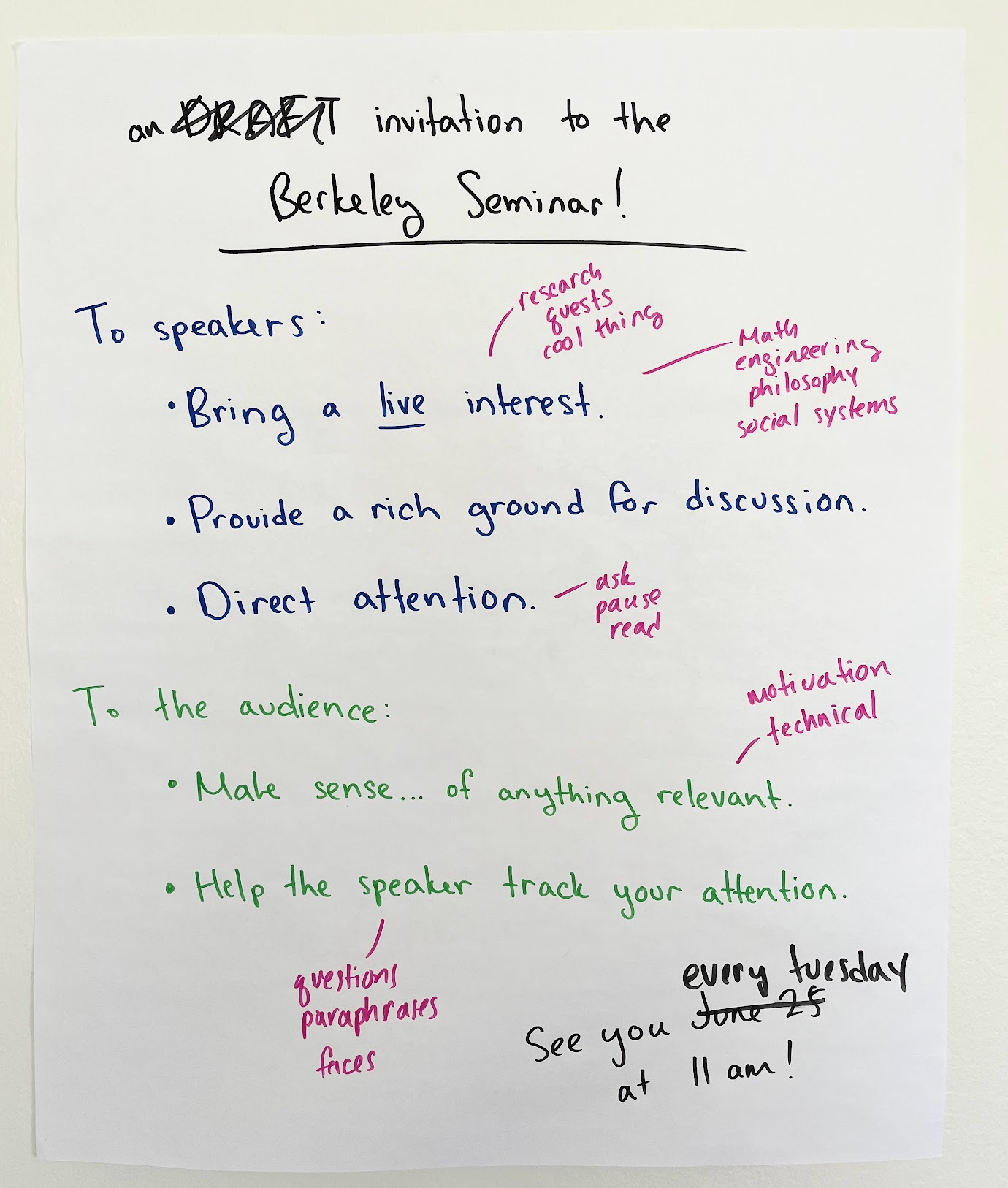
Can we build a tradition of math talks which invites the audience to engage not only with the speaker but also with each other? That is, a seminar that starts as a lecture and ends as a conversation. In this post, Sophie and Priyaa discuss how such a seminar might look based on previous…

Sophie Libkind, Priyaa Varshinee Srinivasan
2nd of August, 2024

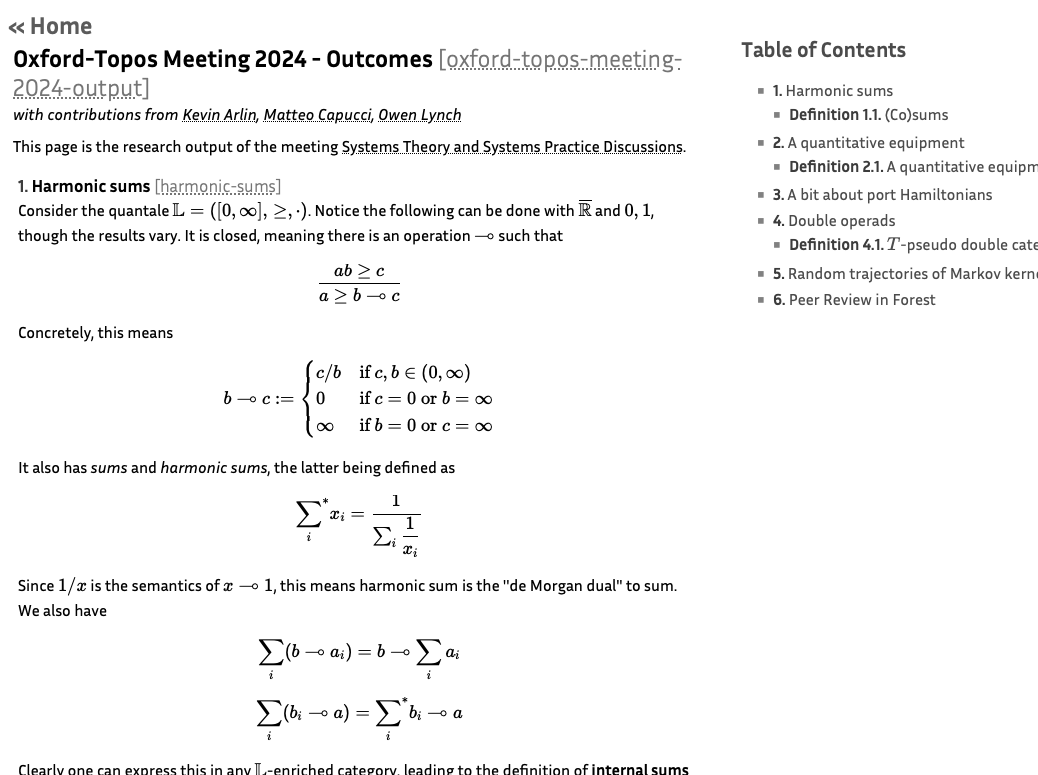
A Retrospective on the Oxford–Topos Meeting

Sam Staton, Paolo Perrone and I organized a small meeting between Topos Institute and the Oxford CS department. It was kind of like a workshop, but because of the short time frame that we planned it on and limited funding, we didn’t invite all the people we’d like to invite or have it open to…

Owen Lynch
13th of March, 2024

A Rosetta Stone for our vignettes

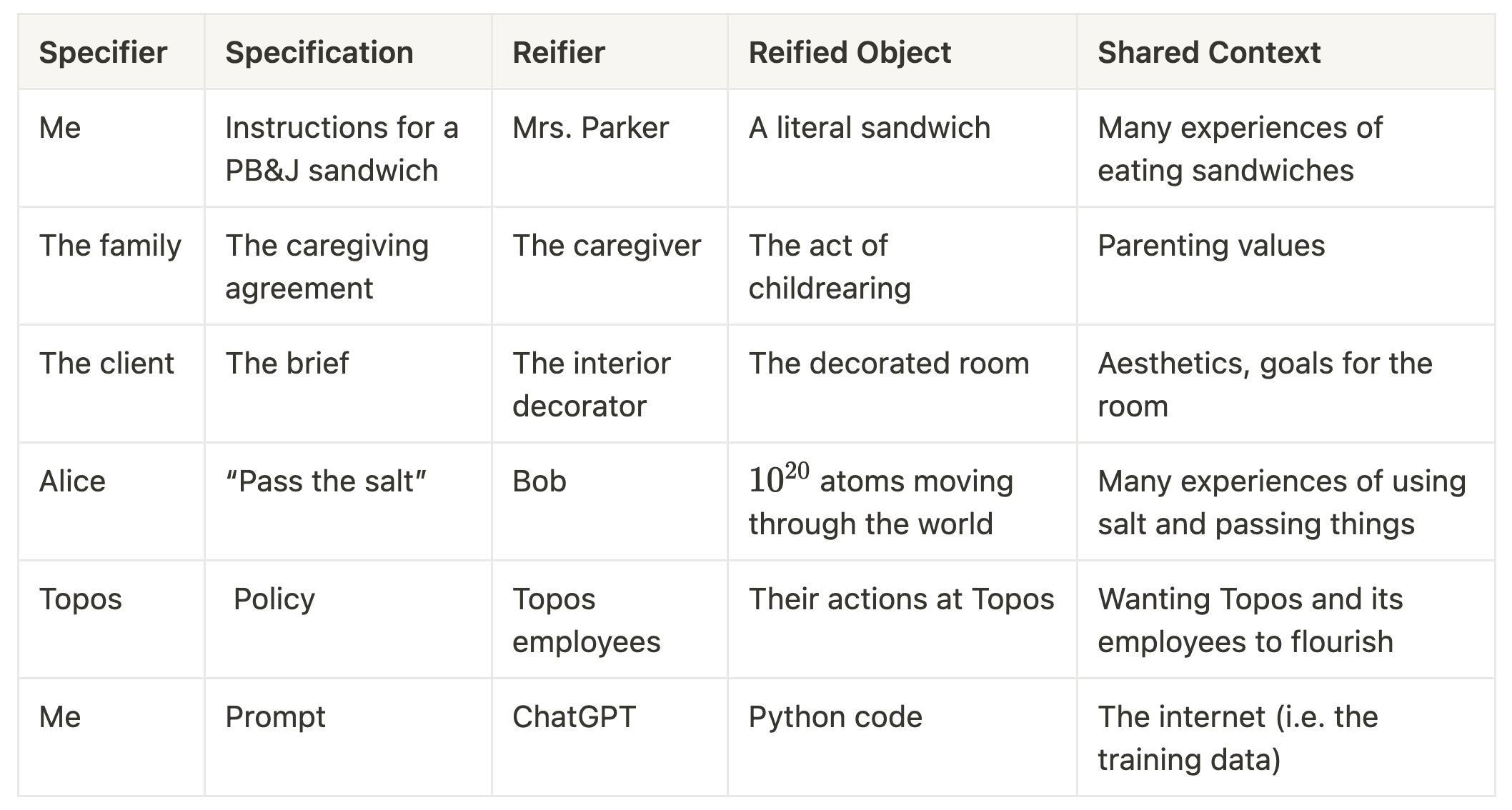
Trustworthy Reification

Not all meals created from the same recipe are equally delicious. Not all programs that accurately sort a list are equally useful. High-level specifications, such as a recipe or a prompt, are only practical because I trust the chef or engineer to execute them in a way that aligns with my values…

Sophie Libkind
5th of December, 2023

Dialogue on a mathematical approach to the good

This post is a dialogue and consists of two parts. In the first part, Bartłomiej Skowron and David Spivak consider what mathematics and ethics have in common. Though some will think these notions have nothing in common, these authors share the intuition that the opposite is true. In particular…

Bartłomiej Skowron, David Spivak, David Corfield
11th of July, 2023

Towards a Research Program on Compositional World-Modeling

In this post, we lay out a vision and challenge for using category theory to build tools for understanding systems at a global scope.

davidad , Owen Lynch
15th of June, 2023

What made the FRA workshop structure successful?

The Topos Institute recently hosted “Finding the Right Abstractions for Healthy Systems”, with 24 researchers, mainly from the applied category theory and AI safety communities. This is a post trying to understand what made it successful and some ideas for similar events.

Elena Di Lavore, Mario Román
22nd of February, 2023

Where matter and pattern meet

Etymologically, the word matter comes from mother and the word pattern comes from father. Like two parents, matter and pattern represent a fundamental dichotomy: matter is the pure material, unconcerned with our ideas about it; pattern is pure structure, unconcerned with what substantiates it.…

David Spivak
7th of November, 2022

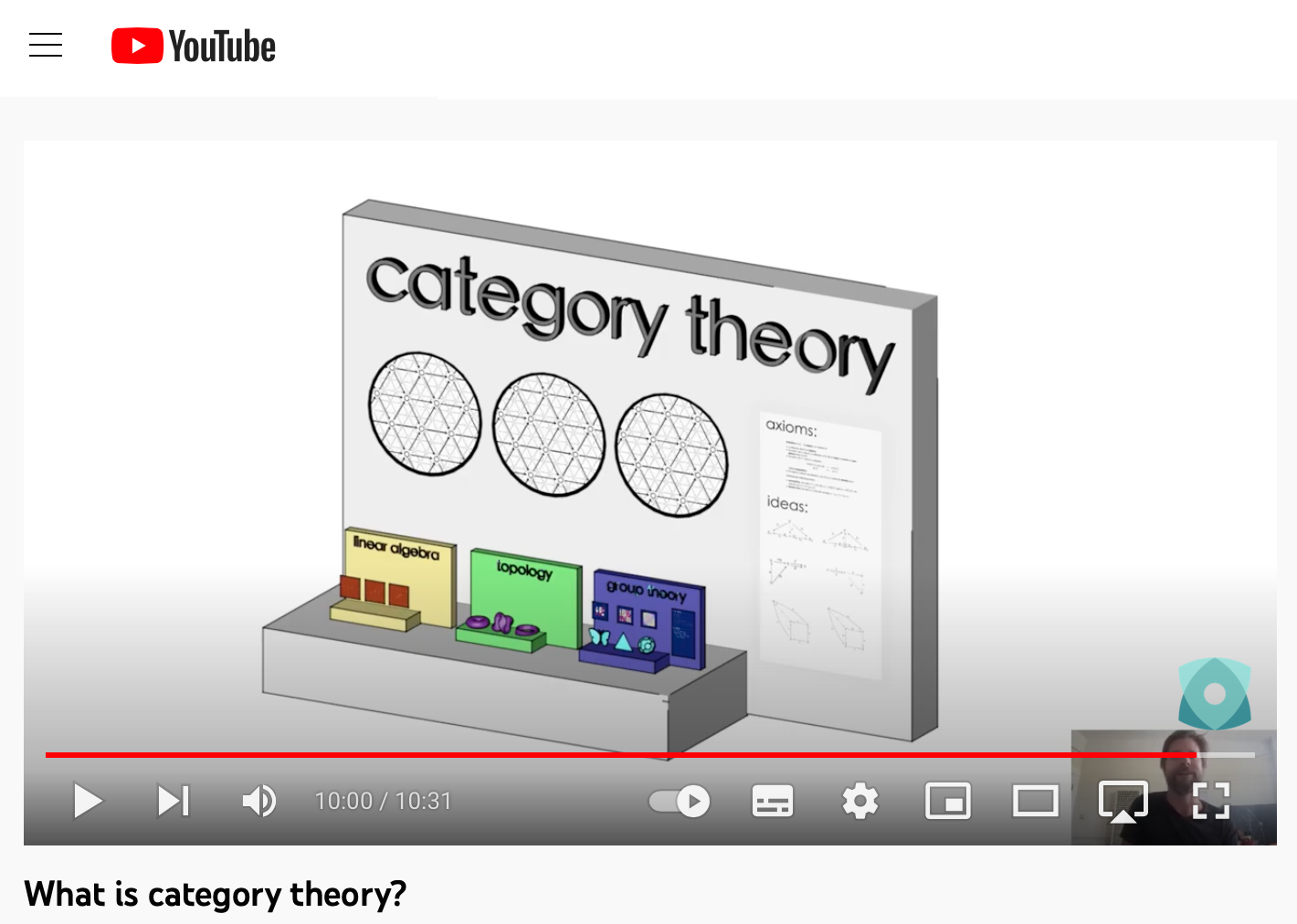
Who is category theory for?

YouTube is our most powerful outreach tool. Yet how does it shape who we reach out to? And is this in line with the values of our community?

Brendan Fong
4th of November, 2022

So, what is category theory anyway?

Ask most category theory experts what it is, and they’ll launch into a session at a white board that can leave your head spinning. That is, if you are not a card carrying mathematician, as many of us are not. Even at Topos Institute, we have staff, donors, and friends who are not mathematicians.…

Tish Tanski, Paul Dancstep
4th of October, 2022

Computation and Category Theory

In a recent talk, David Spivak, my advisor at Topos Institute, described Poly as “the language of computation”, due to its facility in describing concepts in computer science such as data migration, dependent types, and Turing machines. But is Poly really the language of computation? To address…

Joshua Meyers
10th of August, 2022

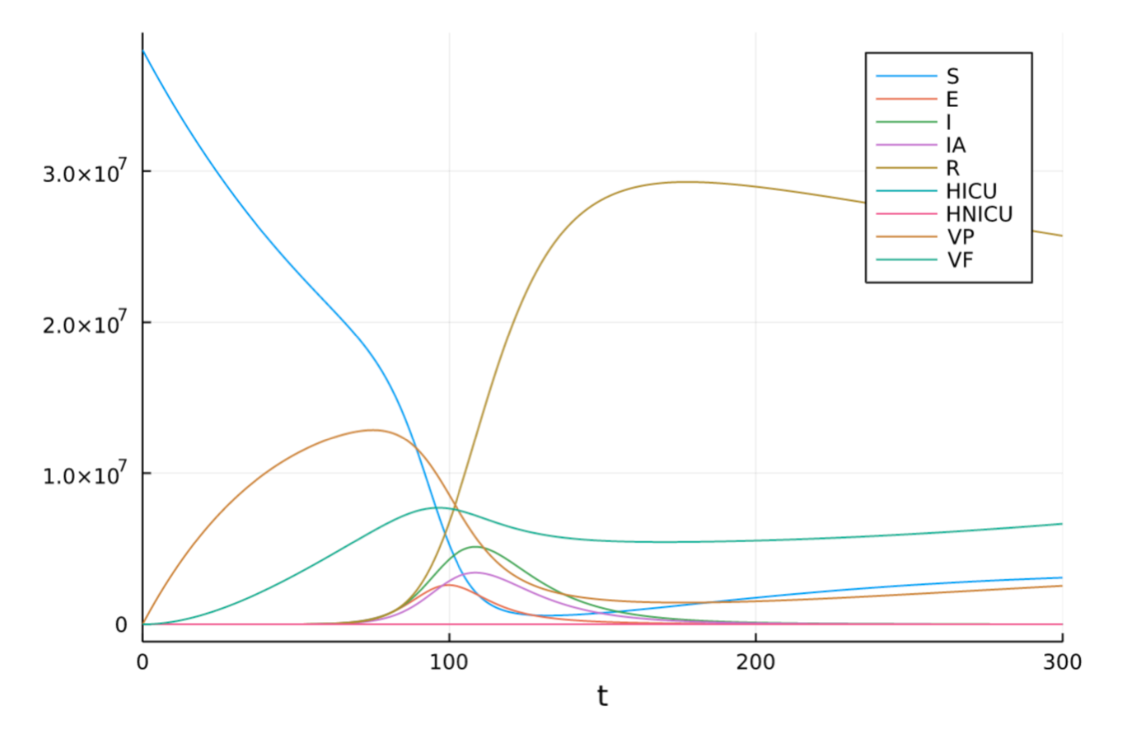
All models are wrong, but…

What makes a good mathematical model? For recent work at Topos, it’s when the model helps people cooperate to achieve collective goals. This has a few implications for how we design modelling software.

Brendan Fong
7th of June, 2022

An account of sense-making

When you say “oh, that makes sense” or “no, that doesn’t make sense”, you’re talking about whether or not the story fits together or adds up right. But you may also say “I have a sense of when people are feeling awkward” or “I seem to use my sense of smell more than other people do”. Could it be…

David Spivak, James Dama
3rd of June, 2022

The “artificial” distinction

I’m like, “oh man, people always talk about ‘artificial’ this, ‘artificial’ that, but what’s up with that? I mean aren’t we humans part of nature too? Are fish and monkeys natural in some way that we humans are not? Are our products somehow not natural, whereas termite mounds are natural? This…

David Spivak
18th of May, 2022

Creating mathematics

People have a wide variety of feelings about math: one considers it horrifically painful whereas another considers it exquisitely beautiful. Some see it as the furthest thing from nature, a human construct of black-and-white thinking; others see it as the most natural thing: the enduring forms…

David Spivak
25th of March, 2022

Brits in Berkeley

Throughout the past calendar year, Topos Oxford has mostly comprised just two people: Toby St Clere Smithe and myself (Tim Hosgood). Since Berkeley has been the Topos site of initial focus, we’ve been working mostly remotely from the rest of the team. But last week was an exciting one for us all…

Tim Hosgood
22nd of March, 2022

Me at the chopped live machine, 1980

Poly makes me happy and smart

There are many reasons people like math; Poly checks all the boxes. My colleague Valeria says our Topos blog posts are often too technical and asked me to write a ‘fluffier’ blog post about Poly, one with a few unicorns and sprinkles. So here goes! Caveat: the author retains the right to…

David Spivak
19th of January, 2022
No matching items
     

    Legal status and annual reports     Cookies policy